AI writes language; domain services perform actions
A model can interpret intent and draft a response, but order, payment, billing, account and integration changes pass through deterministic services with independent validation and authorisation.
AI and automation / Jan 2026 to Present
Businesses lose revenue when social enquiries are answered late, business context is fragmented, and follow-through depends on manual coordination. Automating replies alone is not enough: the platform must preserve tenant boundaries, understand catalogue and policy context, hand conversations to people, and keep commercial actions predictable.
I started Sellavie as an independent product and built it across channel ingestion, tenant-aware state, AI orchestration, catalogue knowledge, human takeover, commerce, subscriptions, reporting, web and mobile surfaces, compliance, deployment and production support. Generated language remains separate from deterministic actions that change orders, payments, access or subscription state.
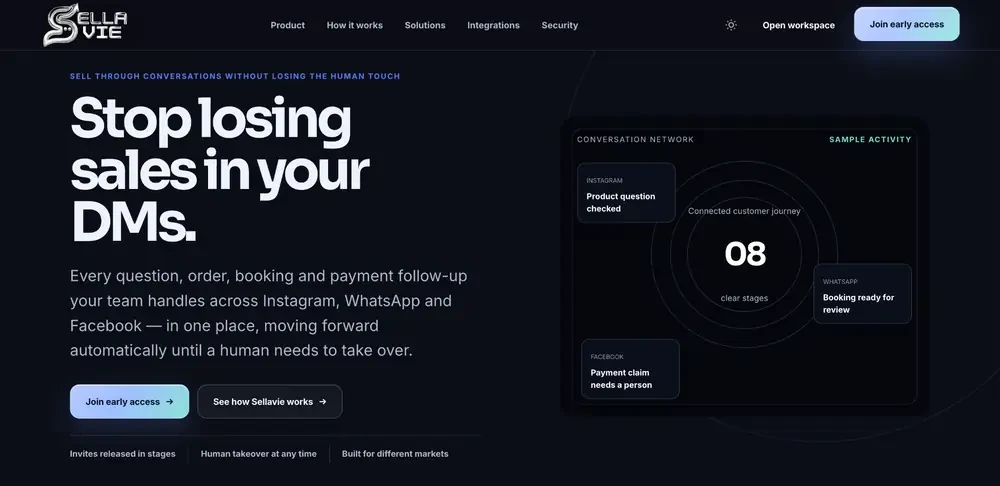
Walkthrough
Signed in to a local build with Sellavie's sample workspace: a grounded reply, an order and invoice created from the chat, a bank-transfer claim that pauses the AI, and a person resolving the handoff.
My part
Decisions
A model can interpret intent and draft a response, but order, payment, billing, account and integration changes pass through deterministic services with independent validation and authorisation.
The connected business, authorised account, catalogue, settings and conversation state are resolved before an AI request is built. Generation is never used as a substitute for tenancy.
Handoff includes pause, acknowledgement, assignment, notes, follow-up expectations and resolution so the business can operate the conversation after automation stops.
Stable internal contracts, idempotency, bounded retries, fallbacks and operational visibility prevent one external service failure from corrupting the wider workflow.
SYSTEM ARCHITECTURE
Instagram, Facebook or WhatsApp message
Signature, event and channel context
Business, role, catalogue and conversation state
Grounding, provider fallback and proposed response
Guardrails, handoff and deterministic domain rules
Conversations, orders, billing, teams and audit
Built with
Links
More work
Gazelle's KitchenA WhatsApp business gatekeeper that qualifies genuine orders, enforces business and safety rules, contains off-topic or abusive conversations, and only surfaces the small set of cases that genuinely need the owner.PilotAI Automation Control PlaneA runnable multi-tenant control plane for AI-assisted business workflows, combining FastAPI, Next.js, PostgreSQL, Redis, n8n, provider routing, human approval, idempotency, replay, cancellation, audit traces, and deterministic local demonstrations.MaintainedWebhook RelayWebhook reliability tool for receiving, verifying, inspecting, replaying, and forwarding events with bounded retries and a live inspector UI.Maintained