This week I took XcroTrust through the most complete release review I have run on one of my own products so far.
The goal was not to produce a wall of green checks. Every case had to end in a state I could defend: demonstrated, justified from the code and contracts, failed, blocked on external evidence, or not testable in the environment I had.
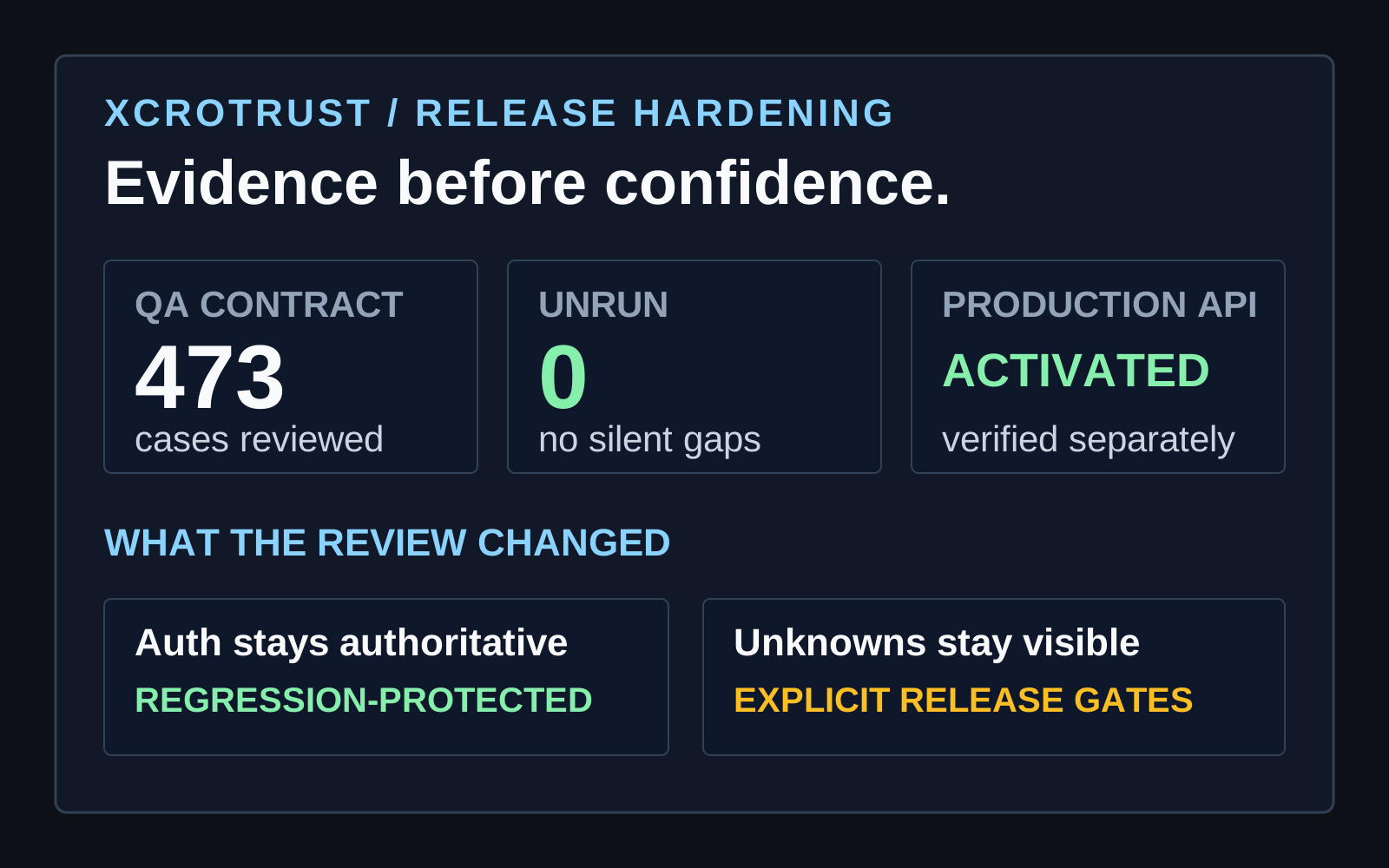
There were 473 cases in the release contract. None were left unrun.
That matters to me because release confidence gets weaker the moment "we could not verify this here" quietly becomes "probably fine."
Passing and knowing are not the same thing
Some behaviour can be proved directly. A test runs, a build completes, a security property is exercised, or a production-safe probe confirms what is actually serving.
Other questions can be answered from the source and its contracts, but that is not the same thing as having evidence from a physical device or an external provider.
Then there are checks that genuinely depend on things the current environment does not have: a real signing identity, store-issued material, a provider response, or a physical device.
I wanted the release record to keep those differences visible instead of flattening everything into one percentage.
The remaining risk is much easier to read that way. A blocked real-device check is not the same as a failing authentication test, and neither is the same as a case nobody has looked at yet.
A useful release review has to be allowed to prove the product wrong
A release process is not doing much if its job is simply to confirm that the implementation is ready.
The XcroTrust review found real defects, in the application and in its release configuration. Each one became a fix and a regression test before the product moved forward.
One of the more useful findings came from a symptom that looked unrelated at first: a mobile sign-in appeared to fail even though the primary API had already authenticated the user successfully.
The problem was that an optional live-updates dependency was being treated as if it had authority over the session. If that secondary subsystem failed temporarily, a valid user could appear signed out.
The fix was architectural, not cosmetic. Authentication stays authoritative. Realtime behaviour can fail, recover and resynchronise without taking the session down with it.
That is exactly the kind of thing I want a release review to expose. It should tell me not only whether a screen works, but whether one part of the system has ended up with authority it was never meant to have.
Production evidence has to identify what is actually serving
Another lesson this week was that a deployment dashboard saying "success" is not the same thing as proving which generation a public domain is serving.
A release check should test the product a user actually reaches and, where possible, identify the serving generation without depending on private console access.
That sounds minor until an old build and a new build can both return the same basic health response. At that point, "the endpoint is up" still does not answer the question I care about: which version is actually live?
So the evidence needs to identify the system state it claims to validate, not just show that something responded.
Some release questions do not belong to engineering
The review also surfaced items that engineering should not quietly decide on its own.
Store declarations with regulatory implications, provider pricing, production signing material and external certification are not made safer by guessing a reasonable answer in code.
Those stay as explicit gates until the right evidence or decision exists.
I would rather have a release record with visible uncertainty than a cleaner-looking one that hides it.
The release record is now part of the engineering system
The strongest outcome is that the QA contract is no longer a one-off spreadsheet sitting beside the codebase.
Tests, release checks, production-safe probes, security assertions and the written release register now reinforce the same boundaries. When a defect changes an invariant, that invariant should live somewhere executable or reviewable enough that the next change has to confront it.
None of this guarantees a perfect release.
What it gives me is a more precise kind of confidence. I can say what was demonstrated, what was inferred, what failed, what changed because it failed, and what still needs evidence from outside the development environment.
That is a stronger release claim than simply saying the test suite is green.